
Controlling Pests of Cassava Leaves and Stems
Cassava pests include insects, mites, and vertebrates. Pests attack and feed on various parts of the cassava plant.
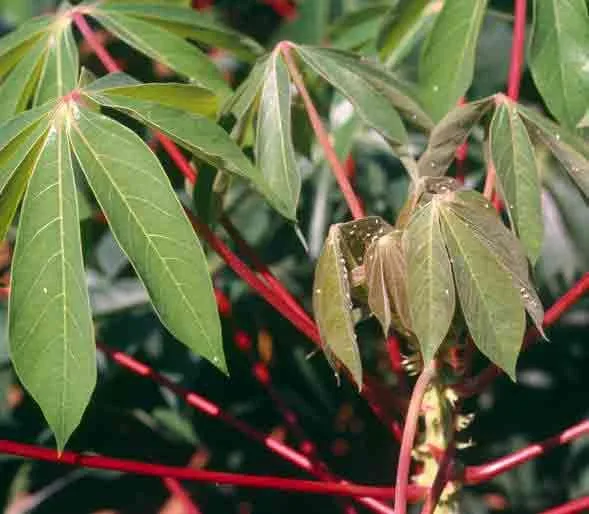
Cassava pests include insects, mites, and vertebrates. Pests attack and feed on various parts of the cassava plant. Some feed on leaves and stems, while others feed on stems and roots.
In this article, we'll cover only pests of the leaves and stems. It's also important to know that the best way to control these pests is through a better understanding of them: being able to identify them, know how they operate, and recognize the symptoms they cause on the plant. Without further delay, let's get into it.
Leaf and stem pests
These are cassava mealybugs, the cassava green mite, the variegated grasshopper, and whiteflies.
a) Cassava mealybug
Phenacoccus manihoti appears on cassava stem tips, the underside of leaves, and the stems. These insects cover themselves in an abundant white waxy secretion. They are wingless, pink, oval-shaped, with very short body filaments. Two other types of mealybugs also attack cassava: the green mealybug, Phenacoccus madeirensis, and the striped mealybug, Ferrisia virgata. These mealybugs should not be confused with the cassava mealybug.
The green mealybug is a greenish white. It is not pink. The striped mealybug is mostly found on the surface of the cassava stem. It has two long posterior filaments and two black stripes running along the dorsal surface of its body. It produces threads of white material that are longer than those of the cassava mealybug. The green mealybug is more common on cassava than the striped mealybug.
Damage symptoms:
The cassava mealybug pierces and sucks sap from the leaves and shoot tips of cassava. Internode length shortens and the leaves bunch together, giving a bushy appearance known as "bunchy top." In addition, the pest deforms the stem, dries out the leaves, and, in particularly severe infestations, ends up defoliating the cassava plants.
Reproduction: Cassava mealybug populations are entirely female. The insect lays eggs without mating. For this reason, a single insect can trigger a severe infestation. Clusters of golden-yellow eggs can be seen within the pest's colonies. Insect populations are more numerous in the dry season than in the rainy season.
Mode of spread:
Newly hatched mealybugs are tiny, lightweight, and can easily be blown by the wind from one plant to another. They also survive on stems and are spread through cuttings carried by farmers.
b) Cassava green mite
Appearance: The cassava green mite, Mononychellus tanajoa, lives on the underside of young cassava leaves. Mites are very tiny wingless creatures that, to the naked eye, appear as spots. In the field, you can see them more clearly with a hand lens. Initially green, the nymphs (immature mites) later turn yellowish. Red mites also attack cassava, generally on more mature leaves. They are uncommon and don't cause serious damage.
Damage symptoms:
The cassava green mite sucks sap from the leaves and stem tips of cassava. It is responsible for the tiny yellow chlorotic spots, resembling pinpricks, seen on the upper surface of the leaf. The chlorotic spots caused by the green mite should not be confused with the chlorotic patches of cassava mosaic disease. Young leaves attacked by the green mite become smaller and narrower. The pest destroys the terminal leaves, which fall off, giving the shoot tips a "candlestick" appearance. Damage is more severe during the dry season.
Reproduction: The cassava green mite population includes eggs, nymphs, and adult males and females. Egg-laying in this pest is preceded by mating.
Mode of spread:
The green mite is a very small, lightweight creature, easily carried by the wind from one plant to another. It also survives on stems and is spread through cuttings carried by farmers.
c) The variegated grasshopper
Appearance: Adults of the variegated grasshopper, Zonocerus variegatus, are green with yellow, black, white, and orange markings. Nymphs are black with yellow on the body, legs, antennae, and wings. Young nymphs gather in large numbers on weeds and low-growing plants.
Damage symptoms:
The variegated grasshopper chews the leaves, petioles, and green stems of cassava. It defoliates cassava plants and strips the bark off the stems. Damage from this pest is more common on older plants than on young cassava plants. It is more severe in the rainy season than in the dry season.
Reproduction: After mating, female variegated grasshoppers lay several egg pods, resembling tiny peanut shells, just below the soil surface. Egg-laying sites always have vegetation that shades the ground and keeps it moist and loose - suitable for egg-laying. Often located near cassava fields, these sites are small in size. In most regions of West and Central Africa, adult grasshoppers appear in large numbers at these sites, generally between March and May. Egg hatching begins at the start of the main dry season, usually in October and November.
Mode of spread:
Variegated grasshoppers spread by flying from one field to another. However, the insect doesn't travel long distances. It spreads faster in cleared areas than in zones with dense vegetation.
d) Whiteflies
Appearance: Adults of the whitefly, Aleurodicus dispersus, are a light white color. Adults and nymphs of this insect appear in large numbers on the underside of cassava leaves, where they are covered in an abundant waxy secretion.
Damage symptoms:
By feeding on the sap of cassava leaves, whiteflies secrete large amounts of honeydew, which encourages the growth of sooty mold on the plant. Blackened leaves dry out and fall off.
Reproduction: After mating, female whiteflies lay eggs on the underside of leaves. The eggs appear, like fingerprints, in spirals of white material deposited on the leaf. Pest populations are particularly abundant during the dry season.
Mode of spread:
The whitefly spreads through active flight and through the transport of planting material.
Other crops attacked: Besides cassava, the whitefly feeds on several types of fruit trees (such as citrus, bananas, and plantains), vegetables, and ornamental plants.
e) The Bemisia whitefly
Appearance: Adults of the whitefly, Bemisia tabaci, have light white wings similar to those of Aleurodicus dispersus. However, the Bemisia whitefly is smaller and doesn't cover itself in white material. Adults and nymphs are found on the underside of young leaves. To the naked eye, nymphs appear as pale yellow oval spots.
Damage symptoms:
Bemisia whiteflies suck sap from the leaves without causing physical damage to the plant. While feeding, the insects inoculate the plant with viruses, causing it to contract cassava mosaic disease. This is the main reason the insect is considered a major cassava pest.

Comments (0)
No comments yet. Share your experience or ask your question.