
Sugarcane: Reducing Weeds and Increasing Yields
Intensive sugarcane growing has always faced a challenge in managing weeds, which until now has always relied on synthetic herbicides applied on and between rows.
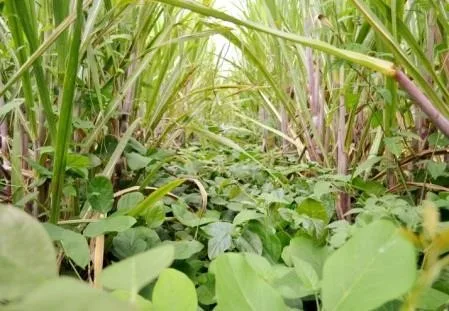
The intensive growing of sugarcane has always faced a challenge in managing weeds, which until now has always relied on synthetic products (herbicides) applied on and between rows, resulting in an increasingly high cost for its production; furthermore, following growing concerns about the use of certain of these products, which may have effects on health and the environment, an innovative intercropping system has been introduced to not only improve this crop's agronomic performance but also minimize the negative impact of synthetic products on sugarcane production.
This cropping system involves using a tropical legume of the Fabaceae family, namely Canavalia ensiformis, or jack bean, which offers multiple benefits, such as:
- Weed control: thanks to its ability to quickly cover the soil with its broad leaves (about 2 months after sowing);
- Nitrogen and organic matter input: it can supply up to 800 kg of nitrogen per 20 t of dry matter, per hectare, per 9-month cycle, according to INRA data;
- Nematode-regulating properties: through the secretion of nematicidal toxins from its roots;
- Value for livestock production: for ruminants, where it makes a good complement to a grass-based forage ration; though it's worth noting it's not recommended for pigs, as it contains an amino acid with anti-digestive properties.
Description of the intercropping system with sugarcane
C. ensiformis is sown in double rows spaced 40 cm x 40 cm apart, between sugarcane rows spaced 1 m x 1 m apart, between 45 and 75 days after planting or harvest. Weeding or post-emergence operations are needed for the cover crop to establish properly. This plant has the particular advantage of becoming spindly under the sugarcane canopy, allowing good movement through the plot while also making the sugarcane easier to cut at harvest.
Thanks to this innovative system, combined with more productive cane varieties, rigorous monitoring, and, in some cases, irrigation, good results have been recorded on several fronts, namely:
- Agronomic: with yield increases ranging from 81 to 148 t/ha, and sugar content ranging from 12.6 to 15.8%;
- Environmental: through a significant reduction in herbicide use.
This makes the system appealing for farming that aims to be increasingly responsible.

Comments (0)
No comments yet. Share your experience or ask your question.