
Making Eco-Friendly Charcoal in Cameroon: Earn Money from Your Waste
Making eco-friendly charcoal, also known as biochar or green charcoal, from household waste, agricultural waste, and biodegradable refuse is a genuine way to fight deforestation.
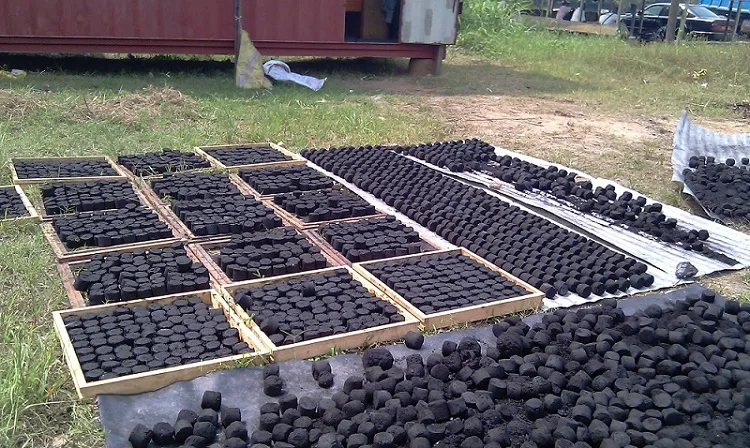
Making eco-friendly charcoal, also known as biochar or green charcoal, from household waste, agricultural waste, and biodegradable refuse is a genuine way to fight deforestation, an important environmental issue for the development of communities, and it's also a real source of income, since it's a profitable activity.
Producing green charcoal in Cameroon in particular, and Africa in general, helps solve the environmental problem of household waste management - a sector that plagues our societies - and helps preserve the biodiversity of our forests. Furthermore, there are many uses for household waste (kitchen scraps, biodegradables). Beyond making compost, it can be turned into an alternative fuel to the traditional wood charcoal used in our households.
How to make charcoal briquettes:
Many people wonder how to make charcoal from waste. This question will be answered briefly here, to give you an overview of how biochar is made.
The different steps for making green charcoal:
1. Collecting the raw material
This involves sorting and collecting the raw materials (plant waste, household waste, etc.) that will be used to make the eco-charcoal. Large pieces of waste must be shredded into small pieces (about 15 cm x 15 cm) to make the carbonization step easier.
2. Drying
A high moisture level in the waste lowers carbonization yield. That's why it's important to dry the collected waste in a dryer to reduce its moisture content as much as possible.
3. Carbonization
Also known as pyrolysis, carbonization is a fairly simple technique that involves placing an organic product (rich in carbon) under carefully controlled heat, in an oxygen-free environment, to produce charcoal. This can be done in metal drums well suited and specially adapted for this technique.
However, the heat needed for carbonization comes from the material being carbonized itself (plant waste, etc.) - meaning the collected raw material is set alight inside a closed chamber.
4. Adding a binder
To ensure the charcoal ash particles obtained from carbonization stick together, a binder must be added.
This binder can be clay powder, starch, etc., mixed with water at a ratio ranging from 10% to 20% in the case of clay.
5. Compacting
Agglomeration, compression, or densification: this step involves shaping the charcoal obtained into briquettes for easier use. This is done using small specialized machines that can compact or densify this charcoal ash.
6. Drying the briquettes
The densified charcoal must then be dried before it can be used. Drying can be done by spreading it out in the sun, or more effectively in a well-ventilated dryer. Note that two to three days of drying is enough, depending on sunlight exposure.
Conclusion on the eco-friendly charcoal-making process:
Earning money from your waste in Cameroon, and across Africa, is now possible. Not only is it a genuine source of income, eco-friendly charcoal also helps preserve the environment.

Comments (0)
No comments yet. Share your experience or ask your question.