
Technical Factsheet: Growing Ginger (Djindja)
Ginger, Zingiber officinale, is an herbaceous plant native to Asia. Ginger is grown for its rhizomes, which, dried, are used as a spice in many dishes.
Contents 10
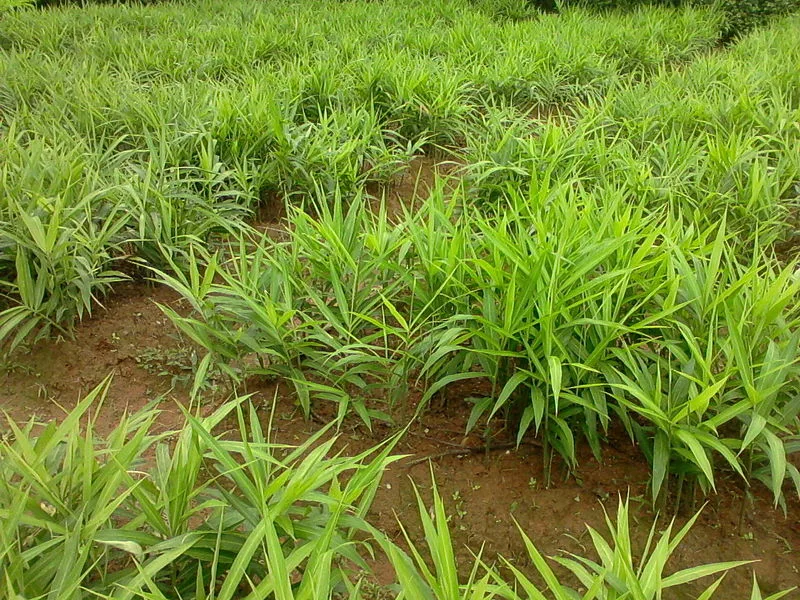
Ginger, Zingiber officinale, is an herbaceous plant native to Asia. Ginger is grown for its rhizomes, which, once dried, are used as a spice in many dishes for their delicate aroma and somewhat sharp flavor. Commonly known as "Djinja" in Cameroon, it is eaten fresh, dried, or as a powder. Bakers and confectioners also use it for preserving meat. Here is a technical factsheet for successfully growing ginger in Cameroon and elsewhere.
I. Favorable conditions for growing ginger
Ginger loves a tropical climate where the temperature is high for at least part of the year, with abundant rain, sunshine, and little wind. During the growing cycle, ginger needs about 1,100 liters of water/m2, i.e. 11 million liters of water/ha, to produce good ginger. Average annual rainfall should also exceed 2,000 mm; otherwise, supplementary irrigation is needed if rainfall is below 1,000 mm. It grows in regions at altitudes between 500 and 1,500 m.
To thrive, ginger needs very light, rich, acidic, stone-free soil so its rhizome can develop properly. The ideal soil should be humus-rich, easy to work, and well drained, since it doesn't tolerate excess moisture. Light loamy or sandy-clay soils work very well.
II. Growing techniques
II.1. Propagating ginger
Propagation is done by dividing ginger rhizomes just before growth resumes. Divide by hand into pieces each bearing at least one bud, though the final yield will be proportional to the size of the starting rhizome. Let the cut surface dry well before planting flat near the surface; the covering soil should not exceed half the thickness of the rhizome.
Ginger grows quickly. Since it takes 2 to 3 months before rhizome pieces from a harvested plantation can be replanted, the plants can be left in the ground while waiting to plant. Cover them with regularly renewed mulch to prevent them from drying out.
II.2. Soil preparation
Soil preparation is done in February-March. This step matters a great deal and must be done carefully, since the useful part of the plant is underground.
- Clear the site, systematically removing all roots that could interfere with rhizome development.
- Gather and burn locally any residue that doesn't decompose quickly
- Plow flat or into ridges or beds at least 30 cm high. The soil should be broken up thoroughly.
- Enrich the soil with plenty of compost or chicken droppings, about 40 to 60 tonnes/ha, i.e. 400 to 600 sacks of 100 kg.
II.3. Planting
Ginger is planted between mid-March and mid-April. Use fresh rhizome pieces, each bearing 3 to 5 eyes. They should be cut with a sharp knife into pieces about 2.5 cm long.
The quantity of seed material used ranges from 900 to 1,350 kg/ha.
Submerge a third of the ginger piece in a glass of water. Leave it until the roots are about the size of a thumb. The rhizome pieces are planted at a depth of 10 to 15 cm. Young shoots appear around day 10 to 15 after planting. Emergence is complete by the 3rd week.
Planting density
To achieve a density of 95,000 to 100,000 plants per hectare, use the following spacing:
- Ridge width: 0.90 m
- Distance between ridges: 25 to 30 cm
- Spacing between plants: 15 x 25 cm; 25 x 30 cm; 30 x 30 cm.
II.4. Fertilization
These are soil-depleting plants. Place one or two handfuls of manure, or a mixture of manure and ash, in each hole - equivalent to a base application of 10 to 12 tonnes of manure and more than 2 tonnes of ash per ha.
If the soil is enriched before planting, there's no need to add fertilizer as the ginger grows bigger - all it needs is an adequate water supply and sunlight. However, apply 11-11-22+5.5 or another potash-rich fertilizer at a rate of 20-25 kg/1,000 m2. Apply this fertilizer in a micro-furrow dug parallel to the planting rows, then close it back up.
II.5. Maintenance
Once planted, the beds are covered with a thick layer of leaves that decompose quickly, serving as green manure, but the main purpose is to protect the topsoil from the heat of the sun. Once the young plants are well established, the beds are cleaned through careful weeding. A second mulching, identical to the first, is then applied. This mulching is repeated at the end of the 3rd month.
It has been observed that mulching has a lasting effect that benefits not only the ginger crop but also the crops that follow it.
Stop watering your ginger as soon as the leaves are half yellow, and only resume gradually once the first new shoots appear.
II.6. Diseases and pests
Diseases
On the leaves, several fungi produce spots on both plants.
Pests
Ginger's common pests include red rot and dry black rot affecting the rhizomes. Some species cause root decay and damping-off of seedlings. However, attacks on ginger are generally minor and usually don't require specific treatment.
II.7. Harvest
The sign that ginger is ready to harvest is the yellowing of the leafy stems and their wilting. Ginger rhizomes intended for canning are harvested before full maturity, between late March and early April, otherwise they become too fibrous and too pungent.
From April to June, ginger is harvested to be dried and pressed for oil. In July/August, fresh ginger is harvested and dried. In early September, the last ginger shoots are harvested and used as seed material for the next crop. The seed rhizomes can be left in the ground in the field. Harvesting is done very carefully with a spade or fork. The leaves are discarded, as they are unfit for consumption.
Avoid damaging the rhizomes. They must be cleaned immediately and promptly cleared of roots and adhering soil. Wash the rhizomes and dry them in the sun, where they take on their characteristic pale yellow color.
II.8. Ginger yield
This varies from country to country, from 20 to 30 t/ha. Fresh ginger yields only 20 to 30% dried ginger.
Would you like to invest in agriculture? Don't hesitate to contact us. We offer support services to help you carry out your agricultural projects.

Comments (0)
No comments yet. Share your experience or ask your question.