
Technical Factsheet: Growing Onions, a Sector with a Future
The onion is a plant whose fruit, called a bulb, is harvested from the ground. It belongs to the Liliaceae family, and its scientific name is Allium cepa.
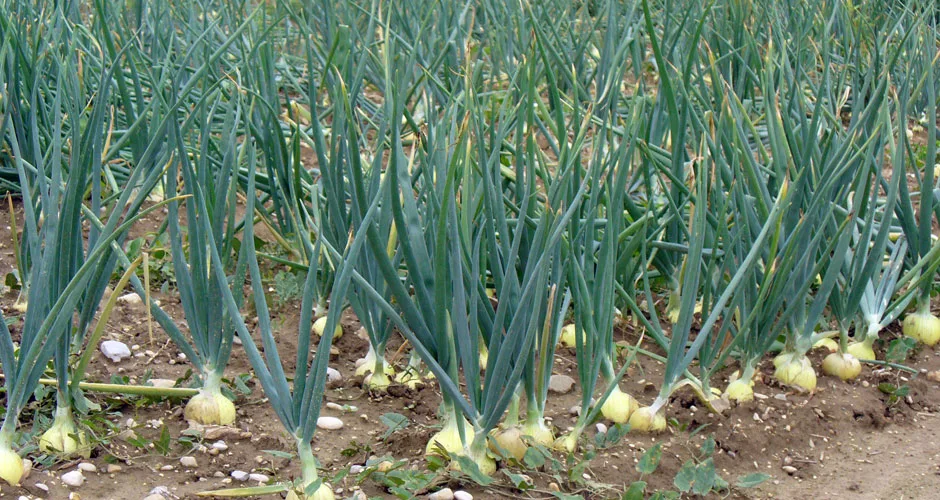
The onion is a plant whose fruit, called a bulb, is harvested from the ground. It belongs to the Liliaceae family, and its scientific name is Allium cepa.
Onions are mainly grown to produce a dry bulb for human consumption. The whole bulb is used fresh, right after harvest or after a few months of storage, as a seasoning and for making sauces. It is eaten raw in salads or cooked mixed with other vegetables. Other parts of the plant are also used: the leaves, harvested green, fresh or dried, and the flower stalks before the umbel opens.
Growing onions in Cameroon
In Cameroon, onion growing is fairly popular among farmers in the Far North and North regions, the country's two main production areas.
Onion growing techniques
To succeed at growing onions, here is a technical factsheet to help you get started with this crop.
1. Soil preparation
Start preparing the soil about 1 month before the planned final planting date. The operations are as follows:
- Clearing and cleaning: clear the site, and gather and burn the branches locally;
- Plowing: plow to form ridges or beds, making sure the plowing depth or bed height is about 15 to 30 cm. If the soil is too compacted, the bulb will form poorly. If the soil is too wet, it can cause the bulb to rot.
2. Sowing methods
There are three ways to sow onions:
- Direct sowing, done from November to mid-December: slightly lower yields;
- Nursery sowing, between November and December: average yields;
- Sowing from bulbils: higher yields, but with more constraints, since the bulbils (small onions) must first be harvested, stored, and then replanted.
NB: avoid growing onions on a plot that just had onions grown on it. The best previous crop is a cereal.
A few available onion varieties
- The Noflaye onion variety gives yields of around 40 to 60 tonnes. It has a very uniform purplish color. Its diameter ranges from 5 to 8 cm. It can be stored for 3 to 6 months. It is resistant to the disease known as "pink root";
- Other varieties exist: Violet de Galmi, Texas Grano, Red Creole, etc.
3. Nursery
Plants that go through a nursery reach maturity slightly earlier than those sown directly. The steps for setting up the nursery are:
- Building beds between 1.2 and 1.5 m wide (2.5 m wide in some layouts) and 10 to 15 cm high;
- Applying well-decomposed manure (goat, sheep, or cattle dung), to which 2 kg/are (100 m2, or 10 m x 10 m) of 20-10-10 fertilizer is added.
Sowing in the nursery should be done between October and December. The nursery stage lasts 4 to 6 weeks. Nursery sowing can be done either broadcast or in rows. If done in rows (which is preferable), sow in parallel micro-furrows, 5 cm apart, traced with a stick the size of a pen, at a depth of 1 cm. Cover with sand or fine soil and firm down well.
Water once a day.
About 5 g of seed is needed for a 1m2 area. A nursery area of 100 m2 is needed to plant 1 ha of onions, i.e. 500g of seed in total.
Five weeks later, the seedlings will be ready to transplant into the field. The quantity of seedlings needed for 1 ha of onions is 3 to 5 kg.
Avoid overly dense nurseries by thinning at emergence, so the plants grow strong.
ALSO SEE: Investing in greenhouse growing: everything you need to know
4. Transplanting
Transplant after about a month in the nursery, once the seedling is already 10 to 15 cm tall. In the dry season, transplanting should be done between October and November, so the harvest happens before the end of the dry season.
Dry-season onions are grown between October and April. This season spans 7 months, and during this time a farmer can only grow onions once on the same plot. It's up to the farmer to time their cycle as needed.
To transplant:
- Water the nursery beds generously before removing the seedlings;
- Avoid breaking the leaves or crushing the seedlings;
- Then expose the seedlings to the sun for a while;
- If the nursery is far from the field, arrange the seedlings in a box, covering them with a damp jute sack;
- It's sometimes necessary to water the nursery beds before pulling up the seedlings;
- Shade is needed to reduce evapotranspiration in young plants (water loss during hot hours). Remove shading gradually 10 to 14 days after sowing.
What planting density should be used?
500,000 to 700,000 plants/ha. This density is achieved with the following spacing:
- Paired rows 15 cm apart on the ridges;
- Spacing between 2 plants: 10 cm;
- Ridges spaced 40 cm apart
For direct sowing in the field, this should be done in November-mid-December.
Cycle length: the growing cycle ranges from 3 to 3.5 months after transplanting, i.e. 4.5 to 5 months from nursery to harvest. During the dry season, which runs from October to May in Sahelian areas, a farmer can grow a single crop, timing their cycle over 4 to 5 months. A rainy-season crop is also possible.
5. Maintenance
- Irrigate once a week if water is needed. It's sometimes better to irrigate every four days;
- Weed whenever necessary, since onion foliage doesn't cover the soil well. Be careful not to damage the bulbs while weeding (for chemical weeding, use Ronstar at a rate of 3 l/ha);
- Stop irrigation or watering about 80 to 90 days after transplanting, or 115 to 120 days after direct sowing.
6. Fertilization
Mainly, apply 20-10-10 or 22-10-15 at a rate of 200 kg/ha before the bulbs start forming. Applying urea increases yields, but the bulbs produced don't keep as long.
7. Plant protection
In case of fungal attack, the leaves show white or yellow spots. Treat with Maneb (one tablespoon in a 15L sprayer).
In case of attack by flies and other insects, their bites or spots can be seen on the leaves. Use insecticides such as Karate, Cypercal 50, or Dursban.
In all cases, first make sure the nursery has been well protected against disease.
8. Harvest
Harvest between 3 and 3.5 months after transplanting, when the leaves turn yellow or bend over at the neck. Irrigation should be stopped about 10 to 15 days before harvest.
How to harvest?
- Lift the bulb out of the ground;
- Once lifted, let the bulbs dry out (cure) for a while;
- Cut the leaves 2 cm above the bulb;
- Store the bulbs in a ventilated place;
- Don't damage the bulb, and avoid making large piles (risk of bruising);
- Don't cover the piles;
- Store under a tree or in a shed
What are the yields?
10 to 20 t on average per ha under smallholder conditions. Under good crop management and with better varieties, these yields can reach 40 to 70 t/ha.
9. Storage
Storing onions poses major challenges.
- Onions are stored in a dry, ventilated space, stacked in layers. Regular checks should be made to remove any rotten or damaged bulbs;
- Storage life ranges from 4 to 8 months depending on the variety. With traditional storage methods, 5 to 6 months can be reached;
- Some varieties, such as Noflaye (sold at Socassem), keep longer.

Comments (0)
No comments yet. Share your experience or ask your question.