
Technical Factsheet: Growing Organic Bell Pepper (Capsicum annuum)
The plot is chosen even before setting up the nursery. Knowing in advance when the seedlings will be ready for transplanting, the key task is to make sure the plot is ready.
Contents 4
I- SETTING UP THE NURSERY
- Prepare a nursery in a shaded area
- Then mix soil, compost, or well-dried chicken droppings to make 7cm x 7cm blocks (potting soil). For example, for about 1,000 blocks, you'll need to add 15 kg of chicken droppings or manure.
- Sow the seeds in the blocks.
- Water regularly, once a day.
NB:
- Germination occurs about 1 to 2 weeks after sowing.
- The seedlings stay in the nursery for 30 to 40 days, i.e. 4 to 6 weeks. After this period, the seedlings are ready to be transplanted.
II- TRANSPLANTING INTO THE FIELD
The plot is chosen even before setting up the nursery. Knowing in advance when the seedlings will be ready for transplanting, the key task is to make sure the plot is ready to receive them about a week beforehand. To achieve this, several operations need to be carried out:
- Clear the land,
- Plant at densities of 15,000 (single row, 1.5 m x 45 cm) to 30,000 plants per hectare (double rows 1.8 m x 0.45 x 0.25). The plant's collar must never be buried (risk of rot).
Add 1 kg of chicken droppings or well-decomposed manure and 2 teaspoons of potassium sulfate to each planting hole, and mix well with the soil. Then water generously.
Also read: Technical Factsheet: Growing Chili Peppers
III- MANAGEMENT AND MAINTENANCE
These operations consist of watering, weeding and hoeing, applying fertilizers, and protecting the crop against diseases and pests. The plants are fragile, and the branches break easily under the weight of the fruit. Plants must be supported and staked.
a) Watering:
In vegetable growing in general, and bell pepper production in particular, regular watering is needed, especially during the dry season, to keep the soil moist throughout the growing cycle.
Watering should be done daily or every two days during fruit swelling, since at this stage the fruits need a lot of water to develop properly.
b) Weeding and hoeing:
Bell peppers cope very poorly with weed competition. That's why the field must be weeded and hoed frequently. These two operations are essential for achieving good yields.
c) Fertilization
As the plants grow, their nutrient needs increase.
Since these nutrients must be available at specific times, split applications are strongly recommended.
d) Plant protection treatment
| DISEASE | SYMPTOMS | PREVENTION |
|---|---|---|
| Anthracnose | Attacks young fruit and causes it to drop before ripening | Neem + Nordox |
| Die-Back | Drying out of stems and branches from the tip down to the base | Nordox |
| Potato Virus Y | Leaf deformation and vein necrosis | Nordox |
| Leaf Miner Flies | White spots forming on the leaves | Fly trap + Neem |
| Caterpillars and Locusts | Attack the leaves, stem, and fruit | Neem |
IV- HARVESTING AND STORING BELL PEPPERS
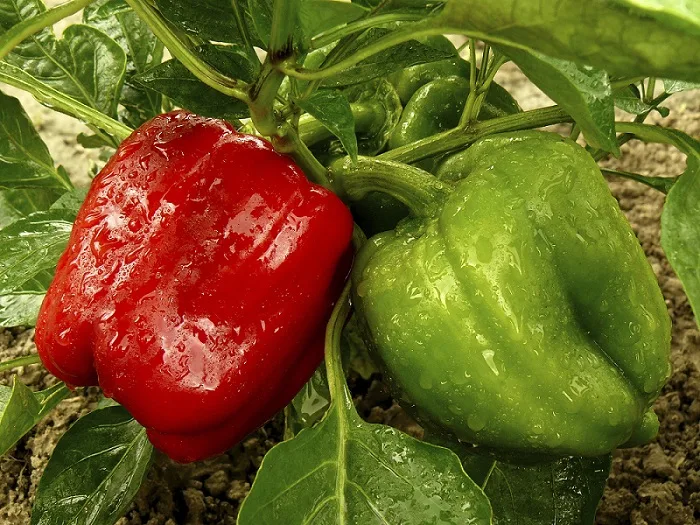
The first fruits are harvested about 10 weeks after flowering, i.e. 3 to 4 months after transplanting, and this harvest can last 3 to 4 months. Ripe fruits should be harvested with their stalk and in dry weather to ensure good storage, which lasts only a few days when fresh.
A fruit should be harvested when it's slightly crisp; this stage coincides with a change in color, while still remaining green. Fruits can be harvested slightly "turning," but the plant is weakened by this; this practice is only worthwhile if a higher price is guaranteed. The yield is close to 300 kg/ha.

Comments (0)
No comments yet. Share your experience or ask your question.