
Technical Factsheet: Growing Plantain Bananas Intensively
In Cameroon, plantain is traditionally grown extensively alongside other food crops, but it can be grown intensively for better yield and profitability.
Contents 5
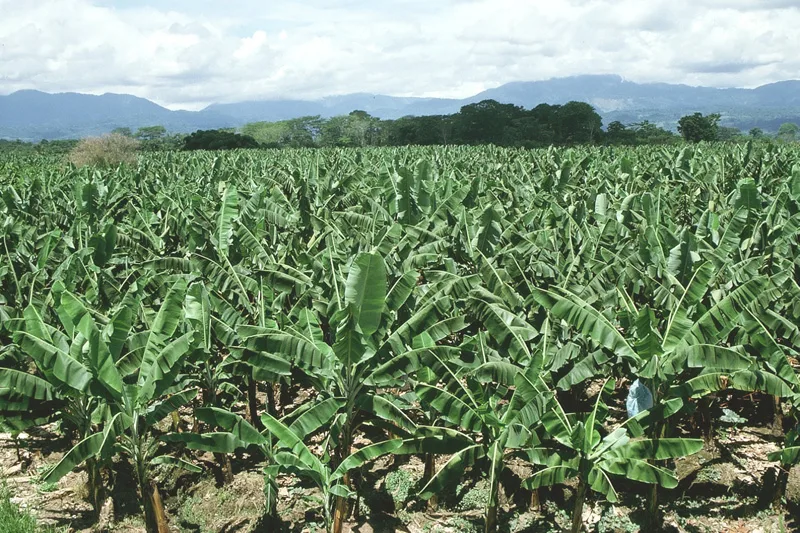
In Cameroon, plantain is traditionally grown extensively alongside other food crops, but it can be grown intensively for better yield and optimized profitability. It can be eaten in many forms: boiled, fried, as chips, roasted, etc. It's a plant that thrives in a hot, humid climate with adequate sunlight for the fruit to fill out well. Here is a technical factsheet, or technical pathway, that will help you succeed at growing plantain.
Technical Factsheet: Plantain Banana (Growing Plantain Bananas)
What ecological conditions are needed for growing plantain?
Plantain growth slows down at temperatures below 25-30 degrees C. This slowdown becomes more pronounced the lower the temperature gets, approaching 14-15 degrees C. At altitudes above 400 m, crops generally show a drop in bunch weight (1 to 2 kg/100m) and therefore a decline in production. Strictly intensive cultivation is recommended below 400m altitude. In regions where this crop can be grown, rainfall is 1,500 mm/year. The ideal range is between 2,000 and 3,000 mm, well distributed throughout the year. The growing cycle lasts 10 to 15 months.
Among Cameroon's ten regions, those with the most favorable conditions for this crop are the Southwest, Centre, South, Littoral, and East.
How to choose good land for growing plantain
The land should be easily accessible, flat or gently sloping, deep, rich in organic matter (more or less black), sandy-clay, well drained, sunny, and well sheltered from strong winds to avoid damage to the plantation. Flooded or poorly aerated land (compacted, waterlogged) should be avoided.
How is the land prepared?
This should be done before the rains arrive, between December and March. Land preparation operations consist of clearing, systematically felling all trees, cutting them up and stacking them in windrows, staking, and digging holes.
Staking the plot:
This involves marking out the hole locations with stakes. It's done according to spacing that varies depending on the variety, soil fertility, and cropping system.
In monoculture, spacings of 3 m x 2 m (3 m between rows and 2 m between plants) or 3.2 m x 2 m are used, giving a density of 1,550 plants/ha. In double or paired rows (1.8 x 2 m x 3.6 m), the density is 742 plants/ha.
In mixed cropping, the spacing is 4 m x 4 m, giving 525 plants/ha, which allows the space between banana plants to be used in the first cycle, then the plant built up to 4 stems in the second cycle.
Spacings of 4 m x 2 m, giving 1,250 plants/ha, allow other food crops such as maize to be permanently grown between the rows of plantain.
Digging the holes:
This should be done shortly before planting the suckers, to avoid the holes filling with water in case of heavy rain. While digging, care must be taken not to mix the darker, organic-matter-rich topsoil with the soil at the bottom of the hole, which is generally more reddish or much less dark. A good hole should have an appropriate length, width, and depth to allow optimal plant growth. It should also take into account the type of planting material used (sucker, PIF, corm with sucker or eye bud, etc.).
Dimensions of 40 cm x 40 cm x 40 cm are recommended for sword suckers or PIF (plants from stem fragments). Dimensions of 50 cm x 50 cm are recommended for corms with suckers or eye buds.
Choosing planting material
Sword suckers should mainly be used - these have narrow leaves less than 10 cm wide, with a well-formed bulb. Water sucker (small suckers with open leaves) should be systematically discarded. A good sucker has a large bulb, free of tunnels, with white flesh when cut. The choice of sucker should also take consumer tastes and preferences, or market demand, into account. The most widely grown varieties are:
- French types (short, numerous fingers, sometimes more than 10 hands)
- False horn types (3 to 6 hands, very long, thick fingers)
- True horn types (1 to 3 hands, very long and very thick fingers, sometimes up to 50cm)
French types are more productive and are preferred over horn types.
How is the planting material prepared?
- The planting material used for replanting should be dug up carefully to minimize damage.
- Suckers with poor-quality bulbs (weevil tunnels, heavy nematode damage) should be discarded.
- Trim with a machete, cutting all roots flush with the bulb, and discard any doubtful material.
- Do a "pralinage" treatment - dipping the bulb in a mixture of mud and a nematicide - and let it dry before planting.
Planting the plantain
- Planting should take place at the start of the rainy season; avoid periods that are too dry or too rainy.
- The black topsoil, mixed with an insecticide or nematicide, is placed first at the bottom of the hole. This hole should be backfilled to about 10 cm below the soil surface.
- Bury the banana sucker or bulb at the center of the hole, up to 8-10 cm above the collar (never more than 10cm), orienting their scars in the same direction, which will make maintenance and staking operations easier.
- Firm the soil around the plants using all the soil dug out, spread an insecticide or nematicide on the surface of the hole, and work it into the soil with light hoeing.
How to maintain a plantain plantation
Weed control
Weeding can be done:
- With a machete (cheap, but short-lasting). Pile the weeds in a ring around the plants; they'll rot and fertilize the plantain.
- With herbicides (costly, but longer-lasting). Application should be done when weeds are between 10 and 20 cm tall. If they're taller, they need to be cut with a machete first, and the herbicide applied to the regrowth. Care should be taken not to let it touch the plantain.
Desuckering:
This means removing all excess suckers, considered parasitic. This should be done every two months. It prevents competition among suckers for soil reserves, allowing high production of good-quality bunches. A significant number of the suckers produced by the corms should therefore be removed. Only the suckers intended to replace stems that have already produced should be kept. Note that by the time the mother plant flowers, 10 months after planting, another banana plant is already ready to succeed it - so a new plant emerges at each flowering.
In mixed cropping (4 m x 4 m): after flowering, keep 4 successor suckers well spaced around the mother plant. This increases output per unit of time and spreads out the bunch harvest.
In monoculture: after flowering, select the most vigorous sucker, best positioned in the planting row, through desuckering. Destroy all other suckers by cutting or uprooting, leaving one successor sucker. The removed suckers can be used as replanting material.
Pruning or removal:
Pruning or removing old and dry leaves from the banana plant - but don't cut the green leaves, which act as the plant's "cooking pots," since they are the site of photosynthesis. Cutting green leaves will result in small, stunted bunches at harvest.
What care should be given to the bunches?
- Stake the plant as soon as the bunch starts forming.
- This is an important practice to prevent the plant from falling over due to wind. For this, either Chinese bamboo or raffia bamboo can be used.
- Remove the male bud 7 to 10 days after the last hand appears, about 20 cm below it.
How to fertilize plantain?
Plantain is a crop that heavily depletes the soil. It responds very well to organic matter. However, this should be applied during the rainy season and not spread too close to the plant. A supplement of mineral fertilizer can be provided depending on soil type and the amount of organic residue applied. Plantain is a plant that likes nitrogen, and even more so, potash. Compound banana fertilizer is of the 12-06-26 type and is applied at a rate of 1 to 2 kg per plant per year, in 3 or 4 applications to reduce leaching losses from rain. Generally applied per round:
- 100g to 200g of nitrogen
- 50g to 80g of phosphoric acid
- 200g to 400g of potash
The fertilizer is spread in a ring, between 1 m and 1.5 m around the banana plants, and immediately worked into the soil by hoeing. Applying organic matter, with a heavy dose of compost (10 to 20 tonnes/hectare), is strongly recommended at planting time, i.e. 100 to 200 sacks of 100kg.
With an average density of 1,200 plants/ha (4 m x 2 m or 3 m x 3 m), 10 to 20 kg of compost or animal manure is needed per banana plant. Chicken droppings are preferred.

Comments (0)
No comments yet. Share your experience or ask your question.