
Technical Factsheet: Growing Potatoes, a Tuber of Major Economic Importance
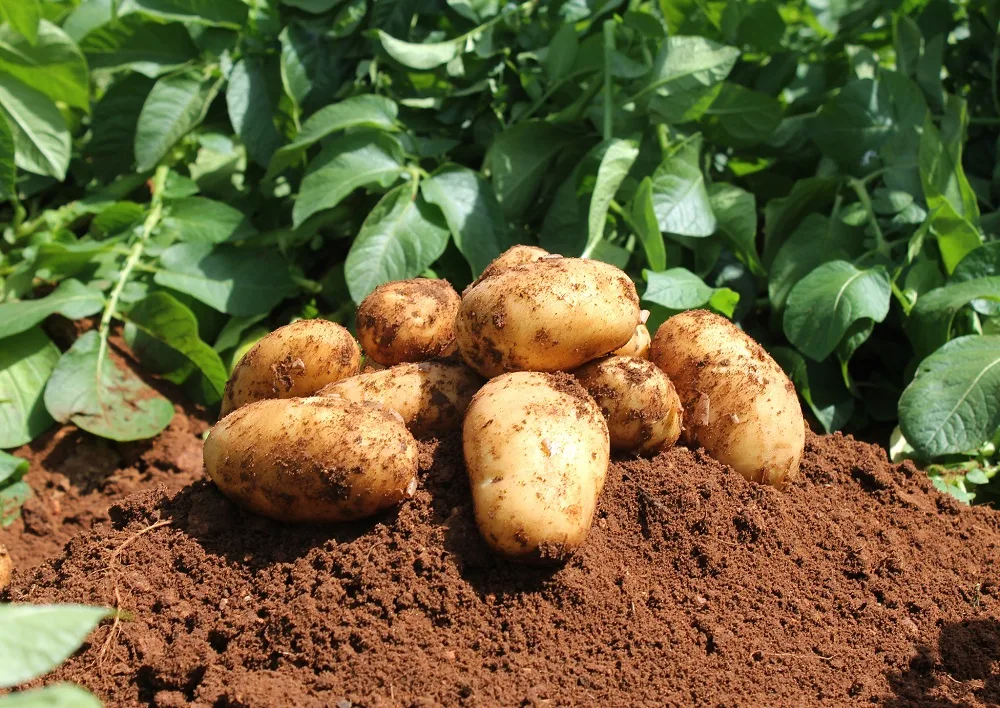
Potatoes are grown for their tuber, which is part of the population's diet. They can be eaten boiled, as chips, or fried.
Contents 14
- I. Technical Factsheet: Growing Potatoes
- I.1. Ecological conditions for growing
- II.2. What are the main potato varieties in Cameroon?
- II.3. Growing potatoes
- II.4. How is the land prepared?
- II.5. Fertilization
- II.6. Planting
- II.7. Maintaining plants in the field
- II.8. Controlling diseases and pests
- II.9. Harvest
- II.10. Sorting
- II.11. Grading
- II.12. Storage
- II.13. Operations during storage
Potatoes are grown for their tuber, which is part of the population's diet. They can be eaten boiled, as chips, or fried. Growing potatoes in Cameroon and elsewhere is in fairly high demand among farmers and investors who want to get into and invest in this economically important crop.
I. Technical Factsheet: Growing Potatoes
Here is a technical factsheet to help you get started and succeed at growing potatoes.
I.1. Ecological conditions for growing
I.1.1. Temperature
The optimal temperature for potatoes is between 15 and 25 degrees C. Temperatures above 29 degrees C stop tuber formation.
I.1.2. Water needs
Potatoes need water throughout their growing cycle, especially during tuber formation. Water needs are on the order of 500 to 600 mm.
I.1.3. Light needs
Tuber formation is directly influenced by light levels. Shade should therefore be strictly avoided.
I.1.4. Soil needs
Potatoes need deep, healthy, rich, well-drained soil. They grow well in sandy or humus-rich soil. They prefer acidic soil, with a pH of 5 to 6.5.
I.1.5. Altitude needs
In tropical regions, potatoes only grow well above 800 m, generally between 800 and 1,800 m altitude. Below 800 m, production drops sharply.
Farmers should therefore choose their plot based on the ecological conditions for potatoes described above.
II.2. What are the main potato varieties in Cameroon?
II.2.1. Local varieties
These have limited performance, though they are adapted to local conditions.
II.2.2. Improved varieties
High-yielding varieties such as: Cardinal (oval tuber, red skin, drought resistance), Cipira (round tuber, white skin, tolerant to late blight, susceptible to bacterial disease), Diamant (long tuber, smooth light skin, resistant to nematodes and drought), Desiree (elongated tuber, red skin, pale yellow flesh), Tubira, Spunta, Bydand, Rubinata, Adora, Manon, Noisette, Duchesse. Four new potato varieties have recently been identified by IRAD, namely: Mafor, IRAD 2005, Jacob 2006, and Bambui Wonder.
II.3. Growing potatoes
Several areas are suitable for growing tubers in Cameroon: the Western Highlands zone, the Adamawa zone, the Mandara Mountains (Mokolo region), the Mbouroukou area near Melong, and the mountainous sites of Bamuck in the South-West. The main production areas are in the regions of Tibati, Dschang, Bangou, Balatchi, Santa, Bamenda, and Mokolo.
It's recommended to use pre-sprouted tubers, since with unsprouted tubers, emergence is uneven, the growing cycle is longer, and the risk of rot is higher.
II.3.1. How to pre-sprout seed potatoes?
Tubers to be pre-sprouted should be medium-sized, healthy, with smooth skin, free of wounds and mold, and have at least two eyes. If they're too large, they can be cut into pieces, coating the cut surface with wood ash to prevent rot. They can also be treated with fungicides.
For good pre-sprouting, the tubers are placed on open-slat trays or shelves in a cool, well-ventilated, well-lit room. The tubers are laid side by side in a single layer, with the sprouts facing up. Sprouting is faster the closer the temperature is to 20 degrees C, and it should be done in the dark. Air temperature and humidity both encourage sprouting.
II.4. How is the land prepared?
This should be done before the first rains arrive.
- Humid regions: February-March for the first season; July for the second season.
- Sahelian regions: April-May
Start by clearing the land, then removing stumps, and finally collecting plant debris and placing it outside the plot to be cultivated - don't bury plant debris. Plow to a depth of 25 to 30 cm; break up clods of earth; loosen the soil. It's best to make ridges, for the following reasons: planting depth will be consistent and even; it helps avoid flooding in certain parts of the field; it limits the spread of disease (tuber late blight, wilt). Ridge spacing should be 80 cm to 1 m depending on the variety. Ridge or mound height should be 20 to 30 cm.
II.5. Fertilization
Potatoes have a strong preference for potash. Use the following mix and rate per 1 ha:
- 500 kg of ...
- 200 kg of ...
- 3 tonnes of ...
Application should be done in a furrow created on top of the ridge, at a depth of 10 to 15 cm, to maximize fertilizer availability; once spread, mix these fertilizers into the furrow using a hoe or piece of wood, to prevent direct contact between the tuber and the fertilizer. The mix is placed at the base, with a second nitrogen dose applied as a top dressing.
II.6. Planting
II.6.1. Previous crop
No solanaceous crops for 3 years (these plants include: potato, tomato, black nightshade, bell pepper, chili, eggplant, etc.). Avoid planting two tuber crops in succession in the rotation. Prefer a fallow period or at least other plants from a family different from that of the potato.
Planting should be timed according to available soil moisture. The cropping method is generally a pure stand, meaning no other plant besides potato is grown on the plot; spacing is 25 to 40 cm between plants on the row; 2,000 kg of seed potatoes are needed per ha; planting density is on the order of 25,000 to 50,000 plants/ha;
Planting depth is 7 to 10 cm. Potato sizes range from 20 to 55 mm. Sizes between 28-35 mm are preferred. Potato emergence occurs about 3 weeks after planting. Always use varieties suited to your area and in demand among consumers. It's also recommended to use fresh seed potatoes each year.
Good to know:
Large-sized tubers weigh a lot (fewer tubers per kilo). However, they produce several sprouts per tuber, and the multiplication rate per plant is high. They also cope better with harsh weather.
II.7. Maintaining plants in the field
II.7.1. Weeding
Keep the field and surrounding area as clean as possible. Weeding can be manual or chemical (using herbicides). Using herbicides doesn't rule out mechanical weeding.
II.7.2. Hilling (earthing up)
This takes place one month after planting, or once the plants are 15 to 20 cm tall. A second hilling is done 2 months after planting. This hilling is done with a hoe and involves taking soil from the furrow and piling it around the base of the plant. The purpose of this operation is to ensure good plant nutrition; support the initiation and development of roots and stolons; keep the stolons in the soil for tuber initiation and bulking; prevent tubers from greening; and protect the tubers against diseases and pests.
II.8. Controlling diseases and pests
Potatoes are affected by 2 broad categories of disease:
II.8.1. Non-systemic diseases
These are contact diseases. The most common are: late blight, early blight, fusarium wilt, scab, brown rot (rhizoctonia), etc. The most widespread in Cameroon is late blight (Phytophthora spp).
Control methods: ...
Product application frequency is as follows: ...
II.8.2. Systemic diseases
These are diseases that circulate within the plant. They are the most dangerous in terms of potato plant degeneration. A diseased plant only produces diseased tubers.
Bacterial diseases
These include bacterial wilt and blackleg. The most dangerous here is bacterial wilt, caused by Pseudomonas solanacearum. Observed symptoms are:
- The whole plant wilts.
- The tubers' eyes release a white ooze.
Control methods include: using resistant varieties, practicing good crop rotation, using healthy seed, avoiding low altitudes, roguing, preventively controlling vectors of these diseases (e.g. nematodes), and following good hygiene practices (disinfection basin, cleaning contaminated tools, etc.).
Contamination can occur through the soil, seed potatoes, runoff water, root-to-root contact, or lack of proper hygiene.
Viral diseases
Observed symptoms include: leaf curling, mosaic patterns, necrosis, or a combination of these symptoms.
Control methods include:
- Using healthy seed;
- Roguing;
- Controlling vectors of these diseases (aphids, whiteflies, mealybugs).
II.8.3. Insects and pests
Pests are varied: insects, nematodes, birds, and rodents.
Insecticide treatments: ...
For cutworms and wireworms, soil treatment is recommended, using a granular insecticide at planting. Combining it with a nematicide is possible.
To control rats and birds, traps and a sanitary buffer of about 5 m are recommended.
Good hilling should also be practiced.
Good to know:
- Roguing means pulling up (with the mother tuber, stem, roots, stolons, and even the surrounding soil) any plant, along with its two neighbors, showing symptoms of systemic disease (wilting, viral disease);
- Off-type plants, as well as those likely carrying latent diseases, are also identified and removed from the field.
- Roguing should be done as soon as the first symptoms appear and continue throughout the plant's growing cycle.
- Removed plants should be discarded far from the field.
- Haulm destruction (defoliation) means destroying the above-ground part or foliage of the plant before it's fully mature.
The purposes of this operation are as follows:
- To allow skin healing, tuber maturation, and skin set, limiting bruising during handling. To stop the progression of diseases (late blight, viral disease). To deter pests.
- Haulm destruction is done two weeks before harvest, by hand-pulling while avoiding lifting the tubers out of the soil.
- Chemically, contact desiccants are used.
II.9. Harvest
Yields vary widely, depending on variety and growing conditions: 7 to 14 tonnes per hectare is the average yield in highland farming. However, yields of 15 to 20 tonnes, or even more, can be reached.
Harvesting takes place 15 days after haulm destruction. It involves breaking down the ridge to recover the tubers, plant by plant.
- Healthy plants should be harvested first;
- Avoid using sharp tools that risk damaging the tubers;
- Avoid harvesting in the rain, as this encourages rot.
II.10. Sorting
Sorting involves setting aside any diseased tubers or those likely to carry disease, as well as any damaged tubers or inert matter (clods of earth and plant debris).
II.11. Grading
This involves sorting the harvested tubers by size. Its purpose is to create uniform lots so that prices can be matched to sizes; it's more economical to grade in the field during collection.
II.12. Storage
A lot's suitability for storage depends on growing conditions and how rigorously diseases were controlled. Make sure the tubers aren't wet. The storage room should be properly cleaned; disinfect it with a fungicide and wait 3 days before bringing in the potatoes. Favorable conditions for good storage are:
- No light sources, which encourage tuber greening;
- Constant ventilation during storage;
- Fairly low temperatures are recommended;
- No overly deep piles, which would cause the potatoes to overheat.
II.13. Operations during storage
- Regularly monitor and sort out rotten or damaged tubers;
- Protect the tubers from pests, with protective screens on ventilation openings.
Would you like to invest in agriculture? Don't hesitate to contact us. We offer support services to help you carry out your agricultural projects.

Comments (0)
No comments yet. Share your experience or ask your question.