
How to Process and Preserve Tomatoes
Tomatoes are widely grown in East Africa and their use is very widespread. However, they are highly seasonal and very perishable.
Contents 6
Tomatoes are widely grown in East Africa and their use is very widespread. However, they are highly seasonal and very perishable.
During the seasonal peak, most farmers sell their tomatoes at knock-down prices and substantial quantities are lost. To minimize such losses, farmers can process tomatoes into various storable products for household use, or into value-added products as a source of income.
Tomatoes are rich in:
- vitamins and minerals, which are important for health;
- lycopene (a substance that makes tomatoes red), which has anti-cancer properties.
Equipment needed for processing tomatoes
Pots, plastic buckets with lids, a sharp knife, clean water, a stove (charcoal, kerosene, gas, or electric), wooden spoons and ladles.
You can use glass or plastic jars and bottles as containers. Plastic is lighter, cheaper, and doesn't break easily.
You'll also need caps for the bottles and lids for the jars. For processing tomatoes on a commercial scale, you'll also need a pulper or blender, a bottle-capping machine, a sealing machine, a glass thermometer, a scale, a chemical preservative, a thickener (pectin), and a solar dryer.
ALSO SEE: How to process cassava into high-quality flour
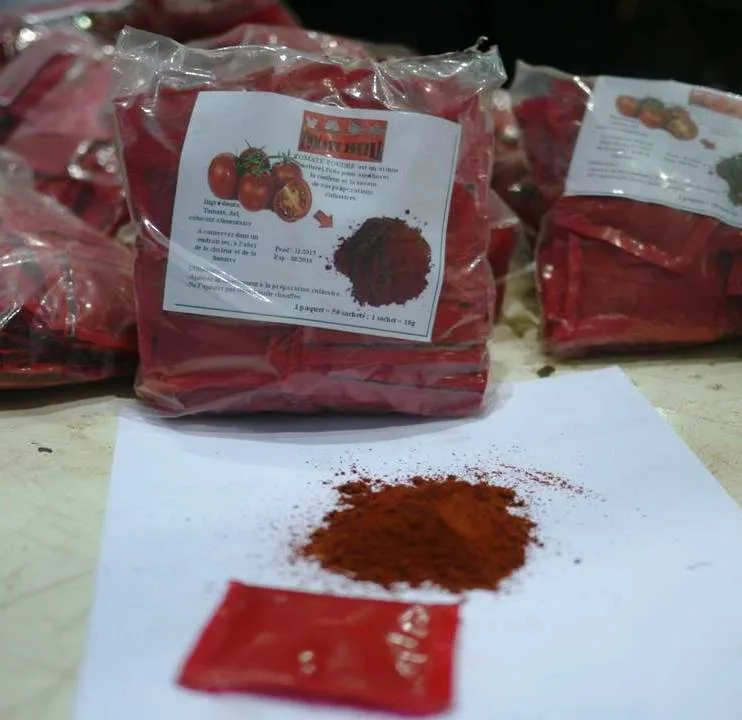
Process for making tomato powder
Step 1: Choosing the tomatoes
Choose ripe, red tomatoes with a firm texture, free of disease and mold.
Step 2: Washing
Wash the freshly harvested tomatoes with clean water in a large container.
Step 3: Slicing
Cut the tomatoes into 0.5 cm thick slices.
Step 4: Drying
Spread the tomato slices on a raised, clean platform to dry in the sun.
Use a solar dryer to get a better-quality product. To prevent contamination of the tomatoes while drying in direct sunlight, cover them with mosquito netting. For commercial production, drying tomatoes using a hot-air dryer is recommended.
Step 5: Milling
Mill the dried tomatoes using a hammer mill fitted with a sieve of the appropriate mesh size.
Step 6: Packaging and storage
- Put the powder into polypropylene or polyethylene bags and seal them with a candle flame or a sealing machine, and write the production date and expiry date (one year later) on the bags.
- Pack the bags into cardboard boxes to prevent damage from light.
- Store them in a cool, dry place.
ALSO SEE: How to Extract Soybean Oil Easily and Quickly
Procedure for making tomato pulp
Step 1: Choosing the tomatoes
Choose ripe, red tomatoes with a firm texture, free of disease and mold.
Step 2: Washing
Wash the freshly harvested tomatoes with clean water in a large container.
Step 3: Blanching
Put the tomatoes in a pot. Add water and boil them until they become soft and their skin can be easily removed, but don't peel them.
Step 4: Pulping
- Remove the tomatoes from the water with a large slotted ladle and place them in another container.
- Mash them with a large wooden spoon.
- Use a kitchen strainer to separate the pulp from the seeds and skins.
- Discard the seeds and skins, or feed them to your chickens, and keep the pulp.
For commercial-scale production, a fruit pulper (manual or mechanical) will lighten the workload and increase output.
The pulp can be used to make tomato jam and tomato ketchup.
Tomato jam
- Use one kilogram of sugar for one kilogram of tomato pulp.
- Mix the sugar and pulp, then put them into a large pot.
- Put the pot on the heat and bring to a boil, stirring constantly to prevent the mixture from burning or sticking to the bottom. Keep boiling until the mixture thickens.
- Add lemon juice (two teaspoons per kilogram of jam). The juice helps the jam set.
- Test to see if the jam has set: take a small amount of jam with a spoon and drop it into a cup of cold water. If it stays together as a ball, the jam is ready. If it disperses in the water, boil the jam a bit longer.
- If the jam isn't firm even after further boiling, add pectin (a thickening agent: one gram of pectin per kilogram of tomato pulp).
- If the jam needs to be stored for more than a year, add a chemical preservative (sodium benzoate, at a rate of 100 mg per kilogram of jam). Add it near the end of the cooking process.
- Sterilize the jars with a sterilizing agent (sodium hypochlorite) or with hot water.
- Let the jam cool and pour it into the jars while it's still liquid and warm enough to flow.
- Fill the sterile jars to about 3 cm from the rim.
- Loosely cover the jars with their lids and set them aside for about
5 minutes to allow air to escape. Then tighten the lids and turn the jars upside down for two to three minutes to heat the lids and kill any germs.
- Let the jars cool to room temperature before labeling them. The jam can be stored at room temperature for a year, provided it hasn't been opened.
- To make 1 kilogram of tomato ketchup, put into a large pot
Tomato ketchup
420 g of tomato pulp and 150 g of sugar. Mix thoroughly and add
300 g of vinegar, 300 g of salt, 70 g of crushed onion, 30 g of crushed garlic, and any other spices to your taste, such as chili powder. Mix well again.
- Bring the mixture to a boil while stirring constantly with a wooden ladle.
- Let the mixture cool for about 5 minutes.
- Pour it into bottles, then close them with caps or seal them with a machine.
- Place the bottles in a pot of cold water.
- Keep cooling the product in the bottles by changing the water in the pot.
- The ketchup can be kept at room temperature for up to 6 months if unopened.
- Use it as a sauce to season your food
Problems and solutions in processing and preserving tomatoes
| Possible problems | Causes | Solutions |
|---|---|---|
The jam doesn't set (doesn't thicken) | You used tomatoes that were too ripe | Use healthy, ripe tomatoes Add lemon juice and pectin |
Mold develops on the product, especially on the surface of the jam | Not enough sugar in the mixture Poor hygiene conditions The jam wasn't boiled long enough Jars not sterile Use of dirty caps and lids | Add the right amount of sugar Use clean utensils Boil as recommended Sterilize the jars Use clean caps and lids |
The jars and bottles crack | The hot product in the jars and bottles cooled too quickly | Cool gradually |

Comments (0)
No comments yet. Share your experience or ask your question.