
Processing Cassava into High-Quality Flour
The tuberous root of cassava can be processed into various forms to obtain different products. Before any processing, select healthy, mature, firm, freshly harvested cassava roots.
Contents 9
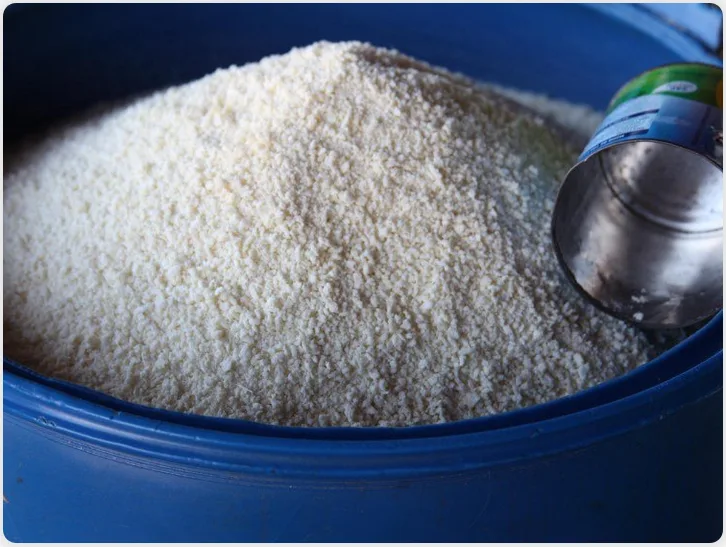
The tuberous root of cassava can be processed into various forms to obtain different products. Before any processing, select healthy, mature, firm, freshly harvested cassava roots, in order to obtain a quality product. Cassava processing produces 2 semi-finished products: cassava paste (which may or may not be fermented) and chips. In this article, we'll look at how to process cassava into flour, a finished product of this crop.
Advantages and importance of cassava
Cassava is a very hardy plant that adapts to a wide range of soils and climates, and is very easy to plant and maintain. In Cameroon, it is grown in at least three of the country's agro-ecological zones, making it an important crop in our diet and an additional source of income for farmers. It's one of those plants where every part can be put to use: the leaves can be used to make soup or as livestock fodder, while the stems and roots can be used respectively as cuttings for new plantings and eaten raw, cooked, or processed into flour.
When it comes to making high-quality flour, this should be done within a day of harvesting the cassava. With a low fat content and a white color, it has a pleasant smell and taste, and blends very well with wheat flour for making cakes and bread. ALSO SEE: How to process and preserve tomatoes
Steps for processing cassava into flour
Step 1: Selecting the cassava roots
This involves harvesting or buying good-quality, firm, freshly harvested cassava; the roots should have whitish flesh, no wounds, no cracks, and very little fiber.
Step 2: Peeling
Here, the skin is removed, along with the stem and any fibrous parts, using a sharp knife. Note that if this step is done poorly, the resulting flour will have a poor color.
Step 3: Washing and grating
Using plenty of clean water, wash the peeled cassava roots to remove any dirt and impurities such as sand, soil, etc. Once this is done, grate the roots using a grater or a mechanical grating machine to get a good result.
Step 4: Pressing
Using a clean sack, such as a jute or sisal sack, place the grated cassava inside it to remove a significant amount of water, using either a rotary press or a hydraulic jack, until the cassava becomes crumbly. ALSO SEE: How to process cassava into starch
Step 5: Drying
To get a better-quality product, solar dryers, ovens, and hot-air dryers can be used, although these are a bit more expensive than spreading the pressed paste on a black plastic sheet laid on a gentle slope, or on a raised sheet of metal protected by netting against birds, flies, and dust. Here, the result will be satisfactory once a nicely floury paste is obtained.
Step 6: Milling and sieving
Once the floury paste is obtained, it is fed into a mill to produce a raw flour, which is then sieved to remove any impurities and fibrous matter. This sieving step is very important, as it produces a high-quality flour with a good texture and free of impurities.
Step 7: Packaging and storage
To ensure good, long-term storage, the flour obtained is placed in black plastic bags that are moisture-proof, sealed using a candle flame or an electric sealing machine, and labeled with the production date and expiry date (six months later). Once sealed, the bags are placed in cardboard boxes to protect them from light and stored in a well-ventilated, dry, and cool place.
Would you like to invest in agriculture? Don't hesitate to contact us. We offer support services to help you carry out your agricultural projects.

Comments (0)
No comments yet. Share your experience or ask your question.